
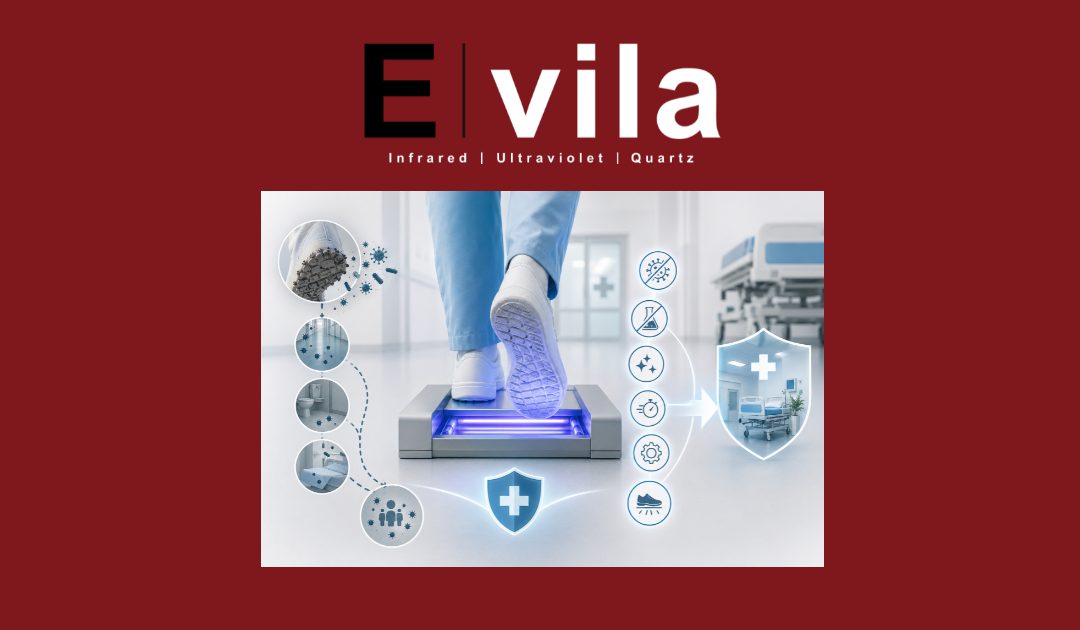
In hospital environments, attention is usually focused on cleaning surfaces, hands, equipment, and air. However, there is one frequently underestimated source of contamination: shoes.
Studies have shown that in just five minutes of walking through hospital corridors or bathrooms, shoes can become contaminated with bacteria and viruses. These microorganisms are then transferred to other surfaces. A clear example occurs when a patient gets out of bed, walks to the bathroom, and returns: bacteria from the floor can be transferred back to the bed, where they will later be touched by patients, doctors, and healthcare staff.
Despite this, floors and shoes are often considered low-risk areas. Although they are routinely cleaned, they are not disinfected, which represents a critical flaw in infection control systems.
Shoes: An Invisible Vector of Transmission
Even the use of shoe covers (booties) does not completely solve the problem:
- Walking over contaminated surfaces still spreads pathogens
- The inside of the shoe cover can also become contaminated
- Every step becomes a mechanism for microbial spread
This turns shoes into a silent factor of recontamination in areas that have already been cleaned and disinfected.
UV: An Innovative and Effective Solution
According to Professor Kevin W. Garey from the University of Houston, UV energy represents one of the most effective solutions to this problem. His research shows that UV devices specifically directed at shoe soles:
- Reduce environmental microbial load
- Decrease bacterial colonization in patients
- Prevent recontamination of critical areas
- Help maintain safer clinical environments
Areas such as operating rooms, ICUs, hospital pharmacies, and critical care units benefit especially from this technology.
Why UV Instead of Other Methods?
UV energy offers key advantages over traditional methods:
- Microorganisms do not develop resistance to UV
- No chemicals are used
- No residues are left behind
- It is fast and easily automated
- It does not depend on human behavior
- It works as direct disinfection of the vector itself (the shoe)
Additionally, there is currently no equally effective alternative for the specific disinfection of shoe soles.
Integrated Strategy: Cleaning + UV
UV shoe disinfection does not replace traditional cleaning—it complements it. The most effective approach is an integrated system:
- Deep floor cleaning
- Environmental UV disinfection
- Specific shoe sole disinfection
- Recontamination control
This combined approach works as a double-barrier system, preventing cleaning efforts from being undone by the constant reintroduction of pathogens.
A New Paradigm in Infection Control
Modern biosafety can no longer be limited to visible surfaces and traditional protocols. Scientific evidence shows that it is necessary to act on all transmission vectors, including those that have historically been ignored.
UV shoe disinfection represents a new frontier in infection control, providing a technological, sustainable, and highly effective solution to reduce cross-contamination in hospitals and healthcare facilities.
Shoes are not a minor detail—they are an active contamination vector.
UV energy applied to sole disinfection helps:
- Reduce healthcare-associated infections (HAIs)
- Protect patients and healthcare staff
- Maintain truly sterile critical areas
- Strengthen hospital biosafety systems
In an environment where every surface matters, every step matters too.