
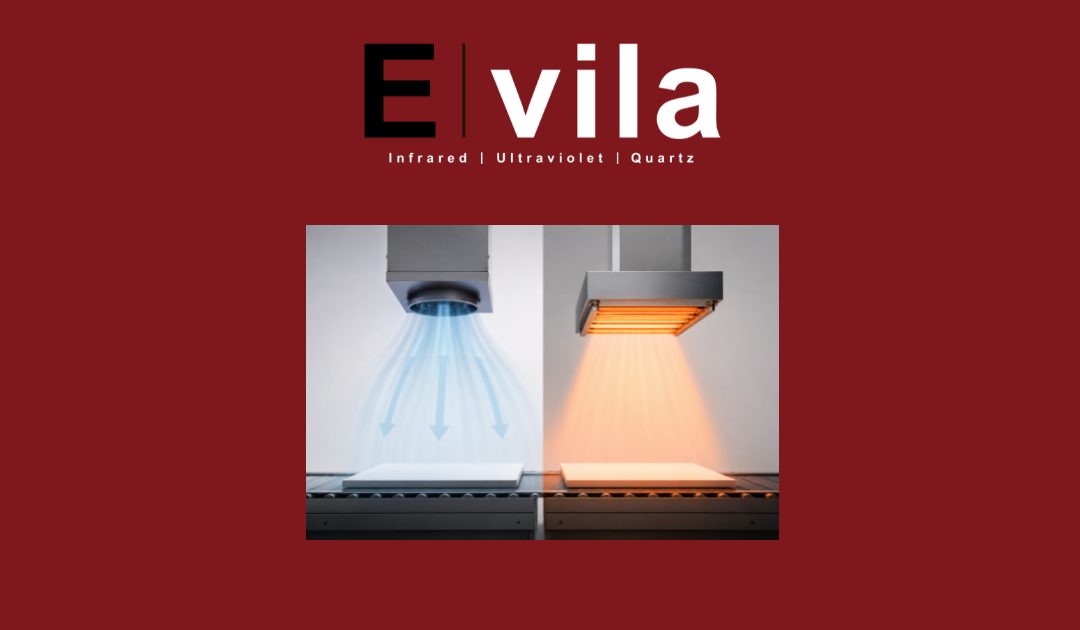
In many industrial processes, drying and heating materials is a critical stage for ensuring product quality, optimizing production times, and reducing operational costs.
Traditionally, many manufacturing lines have relied on hot air systems for drying, curing, or heating applications. However, industrial infrared heating technology has gained significant attention in recent years due to its ability to improve energy efficiency and thermal control.
But which system is actually more efficient?
How Hot Air Drying Works
Hot air systems heat air using burners or electric heating elements and then direct that heated air toward the product surface.
Heat transfer occurs indirectly:
- first, the air is heated
- then the air transfers energy to the material
This technology is still widely used in industries such as:
- paper and packaging
- textiles
- automotive
- industrial printing
- coatings and adhesives
While it remains a reliable and well-known solution, it also presents several important limitations.
Main Limitations of Industrial Hot Air Systems
Higher Energy Consumption
Hot air systems must heat large volumes of air before transferring energy to the product, which creates thermal losses and increases energy consumption.
Slower Response Time
Hot air systems typically require longer startup and thermal stabilization times.
Less Precise Heat Distribution
In certain applications, temperature inconsistencies or uneven drying may occur.
Larger Equipment Footprint
Hot air systems often require ducts, blowers, and larger mechanical structures.
How Industrial Infrared Heating Works
Infrared technology operates differently.
Instead of heating the air, infrared emitters transfer energy directly to the material surface through thermal radiation.
This allows for:
- faster heating
- lower thermal inertia
- improved precision
- reduced energy losses
Industrial IR systems are increasingly used in applications such as:
- ink drying
- industrial adhesives
- coatings
- paper and converting
- plastics
- laminating
- high-speed continuous production lines
Advantages of Infrared Heating Compared to Hot Air
Higher Energy Efficiency
Because infrared transfers energy directly to the material, thermal losses are significantly reduced.
In many industrial applications, this results in:
- lower energy consumption
- reduced operating costs
- more sustainable processes
Faster Drying Times
IR systems reach operating temperatures almost instantly.
This allows manufacturers to:
- accelerate production
- reduce drying times
- improve line productivity
Better Process Control
Infrared radiation can be adapted according to:
- material type
- thickness
- line speed
- required temperature
This enables much more precise and uniform heating.
More Compact Design
Infrared systems generally require less space than traditional hot air systems, making them ideal for retrofits and integrations into existing production lines.
Does This Mean Infrared Is Always Better?
Not necessarily.
Every industrial process has different requirements, and the optimal solution depends on multiple factors:
- product type
- moisture levels
- production speed
- required temperature
- available space
- energy efficiency goals
In many cases, hybrid systems combining hot air and infrared technologies are used to maximize process efficiency.
The Importance of a Customized Heating Solution
One of the most important aspects of any industrial heating system is adapting the solution to the specific process.
Factors such as:
- wavelength selection
- distance to the product
- installed power
- type of infrared emitter
- thermal distribution
can have a major impact on overall system performance.
This is why more industrial manufacturers are seeking customized IR heating solutions specifically engineered for their production processes.
Industrial Infrared Heating Solutions
At E. VILA PROJECTS, we develop industrial infrared heating systems tailored to the specific needs of each application.
Our solutions help optimize industrial drying, heating, and curing processes by improving energy efficiency, productivity, and thermal control across the production line.