
In today’s global environment, sanitary safety has become one of the most valuable assets for any organization. The recent hantavirus outbreak detected aboard the MV Hondius cruise ship in Argentina serves as a critical reminder: traditional cleaning systems are no longer enough.
At E Vila Projects, we develop advanced ultraviolet engineering solutions designed to protect critical infrastructures against airborne pathogens through continuous, high-efficiency UV-C disinfection systems.
The Science of Inactivation: Why UV-C Technology Works
Hantavirus is an enveloped virus highly sensitive to high-intensity ultraviolet radiation. Unlike conventional filtration systems that merely trap contaminants, UV-C technology destroys viruses at the molecular level by damaging their RNA structure, eliminating their ability to infect or replicate.
This is not passive filtration. It is active biological inactivation.
Our systems are engineered to deliver the precise UV-C dosage required to maintain safe environments in complex installations such as cruise ships, healthcare facilities, industrial buildings, public infrastructures, and high-occupancy spaces.
1. Air Handling Units and Ventilation Ducts: Protecting the Building’s Lungs
Airborne transmission through aerosols is one of the primary concerns with viruses such as hantavirus. Ventilation systems therefore become a critical control point.
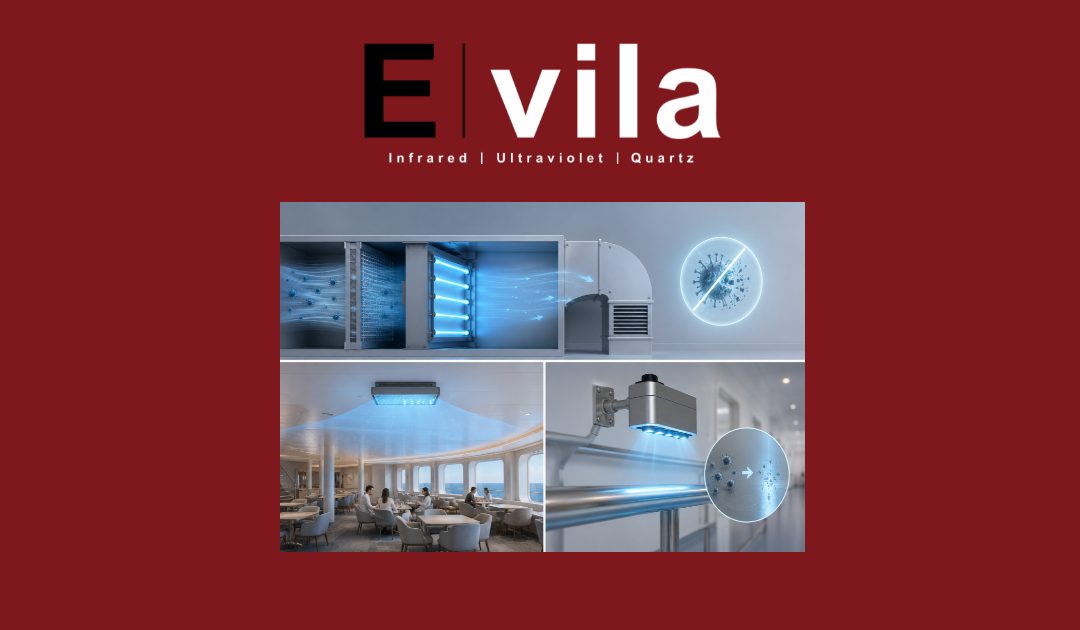
Our UV-C systems integrated into Air Handling Units (AHUs) and HVAC ductwork act as an invisible shield inside the air circulation network.
Single-Pass Inactivation Efficiency
E Vila Projects designs systems capable of delivering effective viral inactivation even under high-speed airflow conditions. Every installation is engineered according to airflow volume, exposure time, reflectivity, and microbial load.
Continuous Coil and Biofilm Control
Beyond air purification, UV-C radiation eliminates biofilm accumulation on coils and internal HVAC components. This provides several additional benefits:
- Improved thermal exchange efficiency
- Reduced maintenance requirements
- Lower energy consumption
- Extended equipment lifespan
- Better indoor air quality
The result is a cleaner, safer, and more energy-efficient ventilation system.
2. Upper-Air UV-C Systems: Continuous Protection in Occupied Spaces
One of the most advanced solutions developed by E Vila Projects is our Upper-Air UV-C technology.
These systems create a controlled disinfection zone in the upper section of occupied rooms. Through natural air convection and ventilation movement, contaminated air circulates into the UV-C zone where pathogens are continuously neutralized.
Meanwhile, occupants remain safely below the treatment area.
24/7 Continuous Operation
Upper-Air systems are specifically designed for continuous operation in occupied environments, providing ongoing airborne pathogen reduction without interrupting daily activities.
Ideal Applications
This technology is especially effective in:
- Cruise ship corridors and dining areas
- Hospitals and healthcare facilities
- Airports and transportation hubs
- Waiting rooms and public buildings
- Schools and educational centers
- Industrial common areas
Wherever people gather indoors, airborne infection risk increases. Upper-Air UV-C adds a permanent layer of invisible protection.
3. Surface Disinfection: Eliminating Risks Beyond the Air
Air purification alone is not enough in high-risk environments. Pathogens can remain active on surfaces and contact points for extended periods.
E Vila Projects complements airborne disinfection with advanced UV-C surface treatment systems designed to ensure homogeneous exposure and eliminate shadow zones whenever possible.
Unlike chemical disinfectants, UV-C systems can provide:
- Chemical-free operation
- No residue generation
- Rapid disinfection cycles
- Automated and repeatable processes
- Reduced human error
Our engineering approach focuses on delivering uniform irradiation distribution across critical surfaces, ensuring consistent performance in demanding environments.
Engineering Confidence for Modern Infrastructure
The future of sanitary protection requires more than reactive cleaning procedures. It requires integrated engineering solutions capable of continuously reducing biological risk in real time.
At E Vila Projects, we design UV-C systems not only to meet current sanitary demands, but to help infrastructures prepare for future biological threats with reliable, scientifically validated technology.
Because in critical environments, prevention is no longer optional — it is infrastructure.