
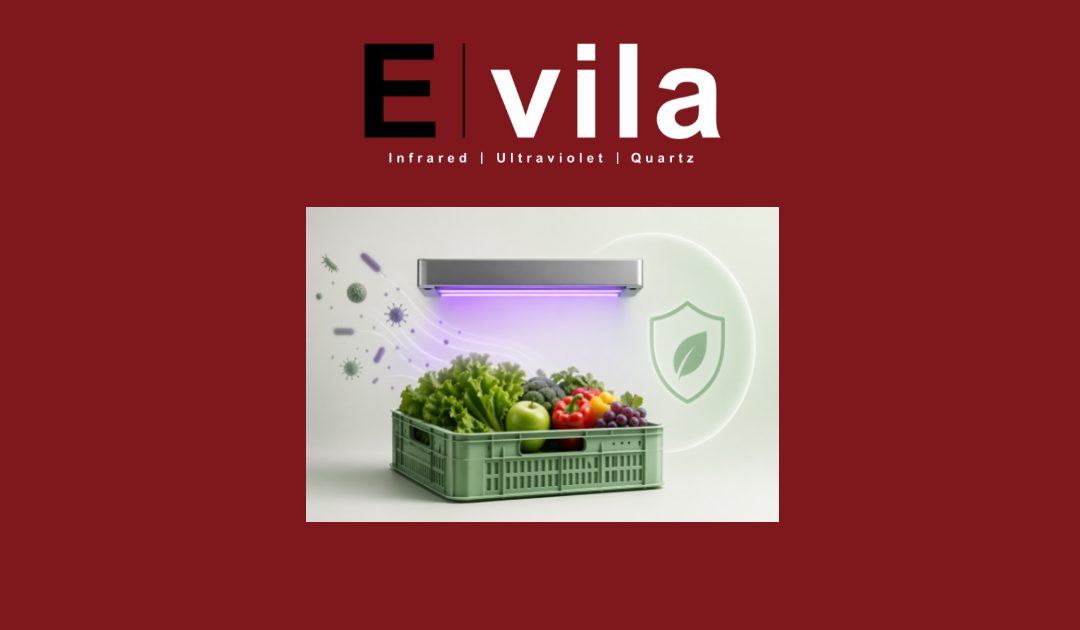
Food safety is one of the biggest challenges in the fresh produce industry. While fruits and vegetables are essential to a healthy diet, they can also become carriers of dangerous pathogens such as Listeria, responsible for some of the most serious outbreaks worldwide.
Traditionally, the industry has relied on chemical sanitizers like chlorine. However, these methods are not always sufficient—especially on complex surfaces such as reusable plastic containers (RPCs), which have cracks and textures where microorganisms can survive for long periods.
This is where UV ENERGY comes into play: a non-chemical, residue-free, and highly effective technology. This radiation acts directly on the DNA of microorganisms, preventing their reproduction and leading to their inactivation. In addition, it does not alter the product, leaves no residues, and can be easily integrated into existing packaging lines.
A recent study showed that, using a specially designed system (UV Tunnel) by E VILA PROJECTS, RPCs can be effectively disinfected, achieving significant microbial reductions in just 90 seconds. Most importantly, the system works uniformly regardless of the container’s orientation, making industrial implementation easier without major infrastructure changes.
Why is this important for the industry?
- Reduces the use of chemicals
- Improves process sustainability
- Strengthens food safety
- Supports “clean label” and organic production initiatives
- Increases consumer trust
UV ENERGY is not meant to fully replace traditional methods, but to complement them—becoming part of a more modern, efficient, and sustainable integrated food safety strategy.
In a world where consumers demand greater transparency, safety, and sustainability, technologies like UV represent a solid step forward in the future of fresh food production.