
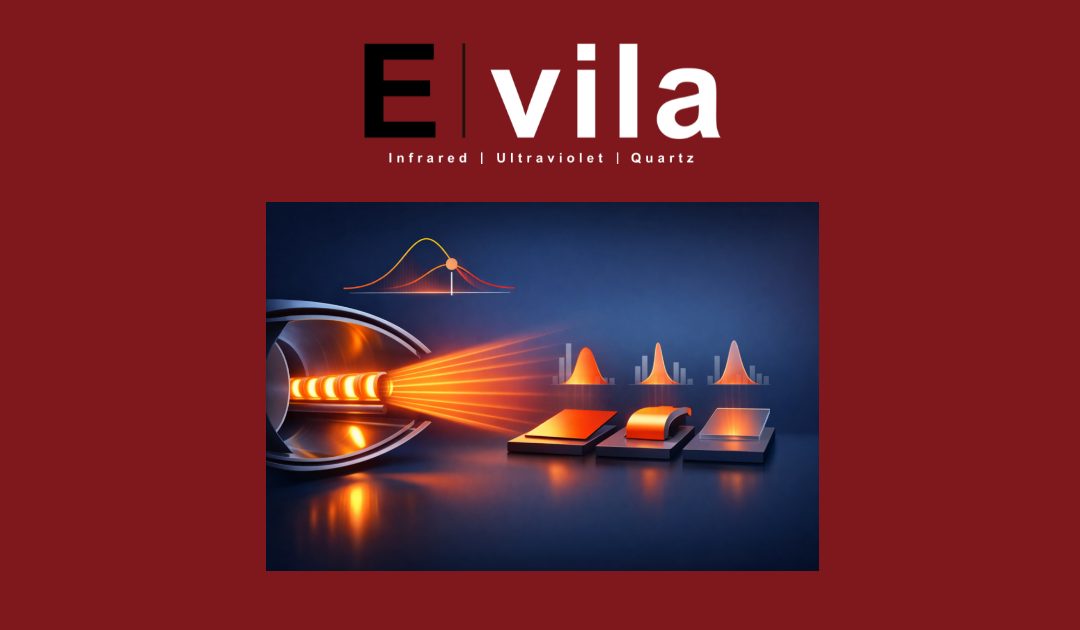
Wavelength Matching Technology: Smarter, More Efficient Industrial Infrared Heating
Wavelength Matching Technology (WMT) represents one of the most significant advances in industrial infrared heating in recent years. Its core principle is simple in concept yet highly sophisticated in execution: emitting infrared radiation at the exact wavelengths that the target material absorbs most efficiently.
Unlike traditional infrared systems — which operate with a fixed emission spectrum — WMT optimizes radiative energy transfer, reducing losses, improving thermal uniformity, and significantly increasing overall process efficiency.
The Physical Foundation: Spectral Absorption of Materials
Every material has a unique spectral absorption coefficient that varies depending on wavelength (λ).
For example:
- Polymers typically absorb more efficiently in the mid-infrared range (2–4 µm)
- Many organic coatings, paints, and varnishes show absorption peaks between 2.5 and 3.5 µm
- Glass and quartz absorb strongly in the mid- and far-infrared
- Metals, on the other hand, reflect much of the infrared radiation and require specific heating strategies
WMT aligns the infrared emitter’s spectrum with the material’s absorption peak, maximizing the conversion of radiation into useful thermal energy.
How Wavelength Matching Technology Works
1. Precise emitter selection
Emitter choice is never arbitrary. It is based on spectroscopic data and the specific thermal behavior of the material being processed.
2. Thermal and electrical control
E VILA PROJECTS systems integrate:
- Precise electrical power control
- <p”>Filament temperature regulation
- Advanced algorithms, simulations, and laboratory testing
By adjusting filament temperature, the emission peak shifts according to Wien’s displacement law, enabling fine tuning of the radiated spectrum.
3. Optical and geometric design
Performance depends not only on wavelength but also on how energy is delivered.
Key design elements include:
- Elliptical or parabolic reflectors
-
Curved or segmented lamps
- Controlled spatial distribution of radiant flux
This ensures energy is delivered exactly where it is needed, avoiding localized overheating and minimizing dispersion losses.
The Result
Greater efficiency.
Lower energy consumption.
More uniform heating.
And precise thermal control tailored to each material.
That’s the power of Wavelength Matching Technology.