
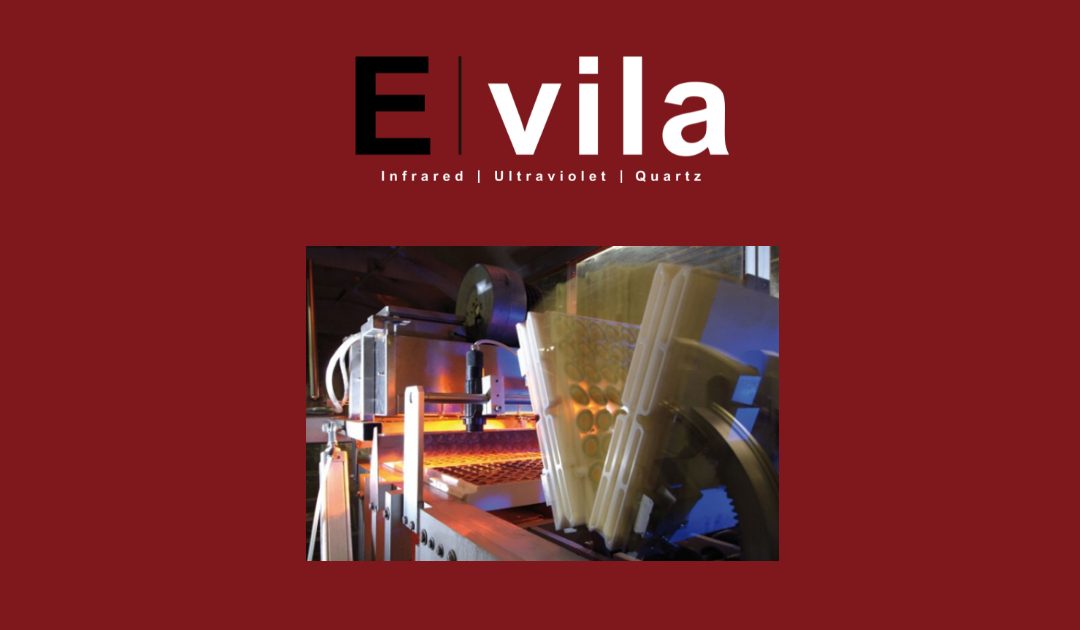
The growing complexity of industrial processes demands advanced tools capable of predicting, optimizing, and controlling the thermal behavior of products. In this context, computational modeling of infrared (IR) heating has become a key element for maximizing efficiency, ensuring quality, and reducing risk in industrial projects.
At E Vila Projects, this approach combines advanced computational modeling with experimental testing in our infrared laboratory. This allows numerical models to be validated and ensures that simulations accurately represent real industrial process behavior. The integration of simulation and experimentation transforms infrared heating into a scientifically engineered process, significantly reducing reliance on extensive empirical testing and shortening commissioning times.
Why Model Infrared Heating Processes?
Infrared heating presents unique characteristics that differentiate it from conventional thermal methods:
-
Direct energy transfer through radiation
-
Dependence on wavelength
-
Critical influence of moisture content
-
Limited and non-uniform thermal penetration
These variables make traditional empirical design insufficient for complex industrial applications. Computational modeling enables:
-
Prediction of temperature profiles within the product
-
Estimation of effective thermal penetration
-
Optimization of process times and power levels
-
Reduction of risks related to overheating or non-uniform treatment
Fundamentals of Infrared Thermal Modeling
Infrared heating modeling is based on the coupled solution of:
-
Radiative heat transfer
-
Internal thermal conduction
-
Mass transfer, particularly related to moisture evaporation
These models can incorporate:
-
Surface or finite penetration of infrared radiation
-
Specific optical and thermal properties of the product
-
Product geometry, thickness, and boundary conditions
Accurate definition of these parameters allows high-precision simulation of real process behavior, even in complex industrial configurations.
Experimental Validation in the Infrared Laboratory
One of the main strengths of the E Vila Projects approach is the experimental validation of computational models through controlled testing in our infrared laboratory. These tests make it possible to:
-
Correlate numerical results with real measurements
-
Adjust thermal and optical product parameters
-
Analyze critical phenomena such as surface drying and thermal gradients
The combination of simulation and experimentation ensures more reliable design decisions and significantly reduces uncertainty during industrial scale-up.
Industrial Benefits of Computational Modeling
Applying computational modeling to infrared heating delivers clear strategic advantages for industry:
-
Energy optimization: precise adjustment of power levels and exposure times
-
Improved product quality: reduction of thermal gradients and material damage
-
Scalability: safe transition from pilot-scale to industrial-scale production
-
Cost reduction: fewer physical trials and reprocessing cycles
-
Higher process reliability: data-driven design supported by real validation
For industrial plants, this results in more stable, predictable processes aligned with current standards of efficiency and quality.