
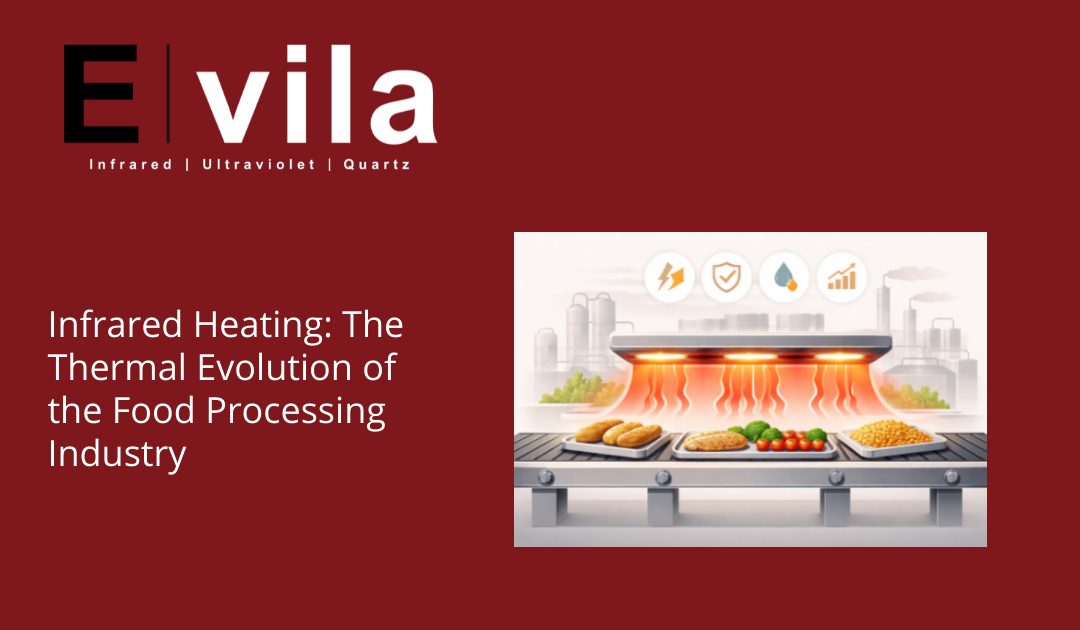
The food processing industry is undergoing a profound transformation driven by three key factors: energy efficiency, product quality, and food safety. Within this context, infrared (IR) heating has emerged as one of the most advanced thermal technologies, with strong growth potential across industrial food processing applications.
Unlike traditional heating methods—based on conduction and convection—infrared radiation transfers energy directly to the product, significantly reducing processing times, energy consumption, and quality losses. This technological evolution is not only a response to operational needs, but also to the increasing demands for sustainability, competitiveness, and precise process control in a global market.
Thermal Processing in the Food Industry: Limitations of Conventional Systems
Historically, thermal processes in the food industry have relied on convection ovens, steam systems, hot water, or electric resistance heating. While these technologies are well established, they present structural limitations:
-
High energy consumption
-
Low heat transfer efficiency
-
Long heating times
-
Loss of sensory and nutritional quality
-
High water usage in auxiliary processes
In these systems, heat is first transferred to air or another medium and only then to the food product, leading to inefficiencies and uneven thermal distribution. As energy costs rise and regulatory pressure increases, these limitations become critical barriers to industrial competitiveness.
What Is Infrared Heating and How Does It Work?
Infrared heating is based on electromagnetic radiation located between visible light and microwaves. Unlike conduction or convection, infrared energy does not require a transfer medium—it propagates as waves that directly impact the product.
When infrared radiation reaches a food product:
-
Energy is primarily absorbed by water and organic components
-
Molecular vibration occurs
-
Heat is generated directly at the surface and near-surface layers
-
The time required to reach the target temperature is drastically reduced
This heating method enables faster response times, greater control, and high energy efficiency—key advantages in continuous industrial processes.
Strategic Advantages of Infrared Heating in the Food Industry
Infrared heating offers both technical and economic benefits, making it a strategic technology for modern food processing plants:
-
High energy efficiency (up to 80–90% conversion)
-
Reduced processing times
-
Lower water consumption
-
Compact and modular equipment
-
Improved thermal uniformity
-
Better preservation of nutrients, color, and texture
-
Easy automation and integration into existing production lines
For industrial companies, these advantages translate into lower operating costs, increased throughput, and stronger competitive positioning.
Industrial Applications of Infrared Heating
Today, infrared technology is used across a wide range of food processing applications:
-
Drying of fruits, vegetables, and grains
-
Industrial baking
-
Roasting and grilling
-
Blanching
-
Dry peeling without water or chemicals
-
Surface microbial inactivation
-
Controlled thawing
Its versatility allows it to be implemented in both continuous and batch processing systems.
The Role of Infrared Technology in the Modernization of Food Processing
The food industry is moving toward more efficient, digital, and sustainable production facilities. In this scenario, infrared heating acts as an enabling technology, supporting:
-
Shorter and more controlled processes
-
Reduced energy footprint
-
Improved thermal traceability
-
Greater operational flexibility
Infrared heating represents a natural evolution of thermal processing in the food industry. Its efficiency, precision, and ease of integration make it a solution fully aligned with the current demands of industrial food processing. Adopting infrared technology is not just a technical upgrade—it is a strategic business decision.